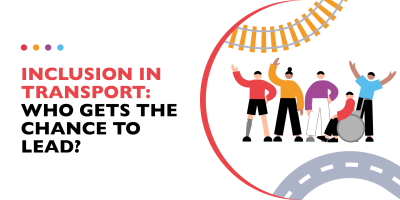
The UK rail industry has taken real and tangible steps in recent years to be more reflective of the public it serves. Schemes to recruit more employees from underrepresented backgrounds, including people from ethnic minorities and women, have started to reap real benefits.
However, it’s undeniable that the industry remains overwhelmingly white and male. With an ageing workforce and a burgeoning skills shortage, it needs to do more to address this imbalance urgently. A crucial part of this involves making UK rail’s leadership more diverse to give others entering the industry a reason to believe that they, too, can progress in their careers.
This question has been a recurring topic on the Intuitive Insights podcast. Hosted by Nina Lockwood, Intuitive’s founder and CEO, the podcast brings industry leaders together to discuss the major issues facing the UK rail sector. But what should UK rail be doing to support those from underrepresented and underprivileged backgrounds as they try to make their mark on the industry?
- Making space for unorthodox career pathways
- Mentorship and leadership development
- Role models matter
- The courage to speak up – and the willingness to listen
Making space for unorthodox career pathways
Not everyone dreams about a career on the railways, although plenty of us do. Indeed, as already stated, many people from underrepresented communities feel that the sector wouldn’t welcome them, so it has to be prepared to welcome people joining from other professional backgrounds.
For example, Louise Cheeseman, former Managing Director of Hull Trains and Director of Bus at Transport for London, told Intuitive Insights that she had worked as a bank cashier before joining Northern Trains at the age of 40.
Transport for London commissioner Andy Lord also said in a recent appearance on Intuitive Insights that he had never had a concrete career plan, as it was impossible to predict what the future might hold. He started in aviation, signing up for a cadet scheme with British Airways before eventually rising to become the head of BA’s regional division.
Mentorship and leadership development
Seeing diverse faces in senior positions in the industry is essential, if we’re to give people from underrepresented communities a real reason to believe that the rail industry offers them a welcoming and supportive environment in which to pursue their career goals.
This is why mentorship and careful nurturing of leadership talent are so important to leadership development. Speaking to Intuitive Insights, Network Rail chief executive Andrew Haines – who comes from a working-class, non-academic background – revealed that he had first entered UK rail after working a holiday job at London’s Victoria Station and joining a British Rail graduate scheme.
Schemes such as these can be vitally important in bringing through talent from underrepresented backgrounds, pairing candidates with senior managers or other professionals who can pass on valuable insights, guidance and support.
Role models matter
While mentorship schemes are highly important in nurturing talent from underrepresented communities, candidates from these backgrounds need to see people like themselves in senior positions if they’re to truly believe that they can make it to a similar position.
Needless to say, this is a long-term endeavour – it will inevitably take time for the industry to make its boardrooms less white and less male. Nevertheless, the presence of visible role models in the upper echelons of the rail sector can serve as a spur to others looking to advance their careers.
Back in 2022, Louise Cheeseman told Nina Lockwood on Intuitive Insights that Dyan Perry, CEO of HS1 and chair of the National Skills Academy for Rail, was “without a doubt” her role model: “She gave me that little push to think, yes, as a woman you can do more in the rail industry.”
The courage to speak up – and the willingness to listen
Making waves in the rail industry requires a willingness to speak up and make yourself heard. But it’s easier for people from certain backgrounds – white, male and middle-class ones, specifically – to speak out than it is for those who are less privileged.
Anit Chandarana, former lead director of the Great British Railways Transition Team, made this point when appearing on Intuitive Insights in 2022, explaining that while it is vital for people from underprivileged backgrounds to make their voices heard, many are still reticent to do so in what remains a predominantly white and male-dominated industry.
Of course, the onus isn’t entirely on people from these backgrounds to speak up – it’s the responsibility of industry leaders to listen. This is why those who have had the good fortune of making it to the top of UK rail must be prepared to listen to what people from underrepresented communities are saying, and take their experiences fully into consideration.
At Intuitive, we take pride in helping talented candidates – from all backgrounds – connect with forward-thinking employers in the UK rail, bus and coach sectors. Get in touch with our expert team of recruiters today to find out more about what they can do to help you, or keep in touch by listening to our regular podcast, Intuitive Insights, and signing up to our regular newsletter.


 Read more